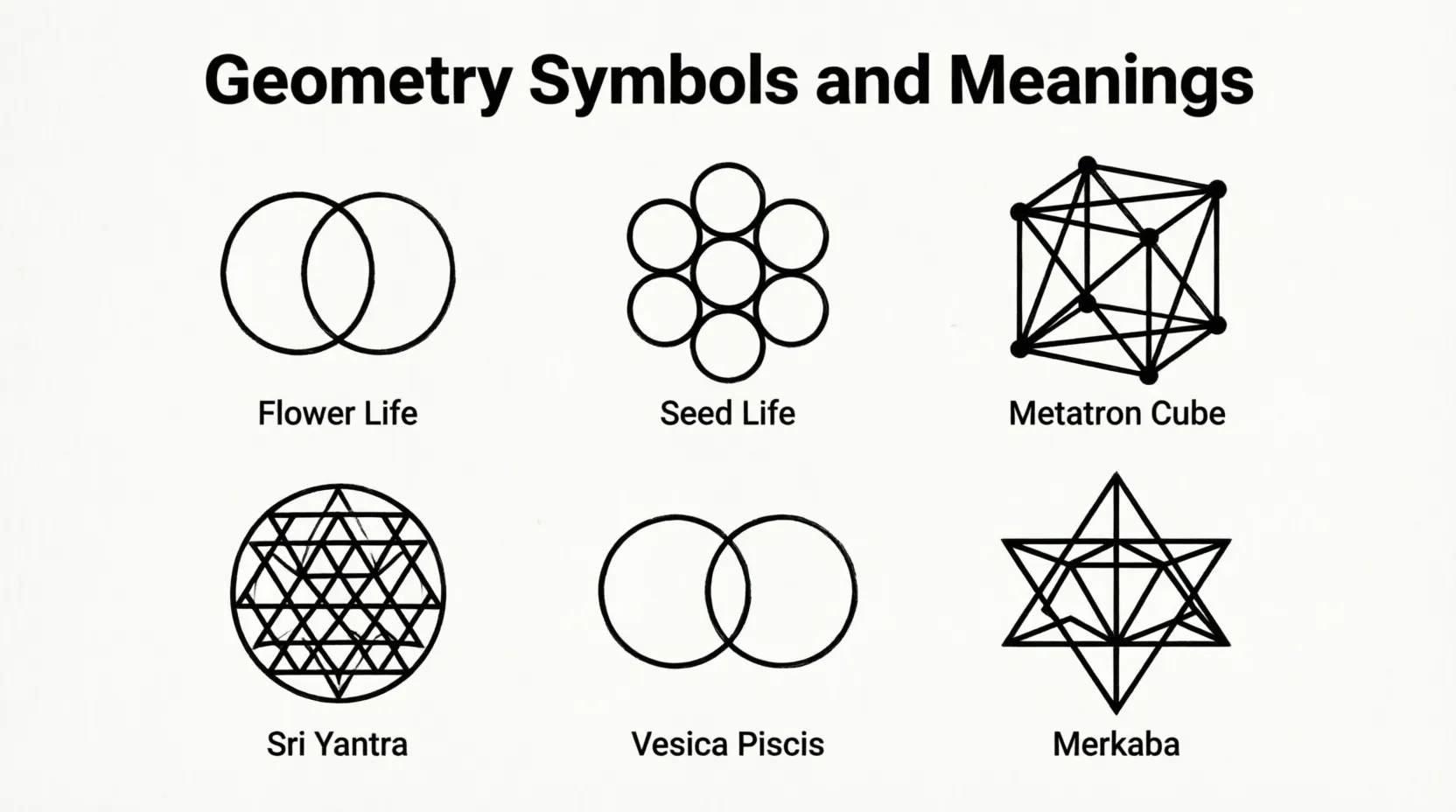
Have you ever wondered why certain patterns seem to appear in ancient temples, religious art, and even nature itself?
Sacred Geometry Symbols and Meanings have fascinated people for centuries because they are believed to represent the hidden order, balance, and interconnectedness of life.
Whether you’re exploring their spiritual significance, cultural origins, or symbolic messages, understanding these timeless designs can offer fresh insight into both history and personal growth.
From the Flower of Life to Metatron’s Cube and the Sri Yantra, each symbol carries unique interpretations shaped by different traditions and beliefs.
In this guide, you’ll discover what these sacred geometric symbols mean, where they come from, and why they continue to inspire curiosity, reflection, and deeper understanding across cultures today.
Quick Answer: What Symbol Represents Sacred Geometry?
The Flower of Life is the most recognized symbol of sacred geometry.
It is made of evenly spaced overlapping circles that create a balanced pattern.
Many people associate it with creation, harmony, unity, and the interconnectedness of all life.
While its meaning varies across traditions, it remains one of the most widely used sacred geometry symbols today.
What Are Sacred Geometry Symbols and Meanings?
Sacred geometry refers to geometric shapes and patterns that many cultures have connected with nature, mathematics, spirituality, and the structure of the universe.
These symbols appear in ancient architecture, religious art, mandalas, temples, and modern design.
Rather than belonging to one belief system, many have been adopted by different traditions over time.
The meanings of sacred geometry symbols can vary depending on their historical, cultural, or spiritual context. For some people, they encourage meditation and mindfulness.
Others simply appreciate their symmetry and artistic beauty.
Understanding a symbol’s origin helps you use it respectfully, especially if you plan to wear it as a tattoo or include it in personal or commercial designs.
Sacred Geometry Symbols and Meanings Comparison Table
| Symbol | Main Meaning | Best Use |
| Flower of Life | Unity, creation, harmony | Tattoos, meditation, wall art |
| Seed of Life | New beginnings, creation | Jewelry, personal growth |
| Sri Yantra | Spiritual focus, balance | Meditation spaces, artwork |
| Metatron’s Cube | Balance and sacred order | Tattoos, spiritual artwork |
| Vesica Piscis | Unity and duality | Logos, religious art |
| Merkaba | Spiritual growth and protection | Meditation, jewelry |
| Torus | Continuous energy and flow | Educational graphics, art |
| Spiral | Growth and life’s journey | Tattoos, personal reminders |
| Hexagon | Balance and efficiency | Logos, branding |
| Golden Spiral | Natural beauty and proportion | Design, architecture |
| Cube | Stability and foundation | Home décor, logos |
| Labyrinth | Personal journey and reflection | Gardens, meditation paths |
Top Sacred Geometry Symbols and Meanings
Flower of Life: The Symbol of Unity
The Flower of Life is one of the best-known sacred geometry patterns. Its repeating circles create a balanced design that many people connect with creation and the unity of life.
Versions of this pattern appear in historical architecture and decorative art across different cultures. Today, many people use it during meditation or as a reminder that everything in nature is connected.
Its symmetrical appearance also makes it popular in tattoos, home décor, and jewelry because it combines beauty with meaningful symbolism.
Best for: Tattoos, meditation, wall art, jewelry, spiritual gifts.
Seed of Life: A Symbol of New Beginnings
The Seed of Life is formed from seven overlapping circles. Many people see it as representing creation, fresh starts, and personal growth.
Because of its smaller and simpler design, it is often chosen by people beginning a new chapter in life, such as starting a family, changing careers, or recovering from difficult experiences.
Its clean structure also makes it suitable for minimalist artwork.
Best for: Small tattoos, necklaces, journals, personal milestones, gifts.
Sri Yantra: Balance Within and Around You
The Sri Yantra is a sacred geometric diagram used in Hindu spiritual traditions. It consists of interlocking triangles arranged around a central point.
Many practitioners use it during meditation to encourage focus and inner balance. Outside religious practice, people often admire it for its intricate symmetry and artistic beauty.
When using the Sri Yantra, it is important to recognize its deep spiritual significance within Hindu tradition.
Best for: Meditation rooms, sacred art, spiritual practice, framed artwork.
Metatron’s Cube: Sacred Order
Metatron’s Cube combines multiple geometric shapes into one detailed pattern. In modern spiritual communities, it is often associated with balance, harmony, and the structure of creation.
Although many interpretations exist, there is no single universal meaning. People are often drawn to it because it visually combines several important geometric forms into one design.
Its detailed appearance makes it especially popular among tattoo enthusiasts.
Best for: Sleeve tattoos, meditation art, spiritual journals, decorative prints.
Vesica Piscis: Meeting of Two Worlds
The Vesica Piscis is created when two circles overlap equally. The shared center has long been connected with unity, relationships, and creation.
It has appeared in Christian art, sacred architecture, and mathematical studies throughout history.
Many designers appreciate its simplicity because it symbolizes two separate parts coming together while creating something entirely new.
Best for: Wedding symbols, logos, relationship tattoos, meaningful artwork.
Merkaba: Movement and Spiritual Awareness
The Merkaba combines two interlocking three-dimensional tetrahedrons. Many modern spiritual traditions associate it with personal transformation and higher awareness.
Some people use it during visualization exercises or meditation, while others simply enjoy its striking geometric appearance.
Its layered design creates an eye-catching piece for jewelry or decorative art.
Best for: Meditation jewelry, tattoos, spiritual décor, mindfulness reminders.
Torus: Endless Energy
The Torus is a doughnut-shaped geometric form often used to describe continuous flow and natural cycles.
It appears in scientific discussions as well as spiritual interpretations. Many people view it as representing movement, renewal, and the ongoing exchange of energy.
Because it symbolizes cycles without a clear beginning or end, it appeals to those reflecting on life’s constant changes.
Best for: Educational illustrations, meditation art, inspirational posters.
Spiral: The Journey of Growth
The spiral appears throughout nature, from shells to galaxies. Across many cultures, it has symbolized growth, learning, and life’s unfolding journey.
Unlike more complex sacred geometry symbols, the spiral is easy to recognize and works well in both modern and traditional designs.
Its simple appearance makes it especially popular for first tattoos.
Best for: Small tattoos, personal reminders, artwork, logos.
Hexagon: Nature’s Perfect Pattern
The hexagon is one of nature’s most efficient shapes, found in honeycombs, crystals, and snowflakes.
Because of this, it often symbolizes balance, organization, and cooperation.
Its clean lines also make it a favorite in modern branding and architecture, where simplicity and structure are important.
Best for: Business logos, branding, architecture, minimalist art.
Golden Spiral: Beauty Through Proportion
The Golden Spiral is based on mathematical proportions often observed in nature and classical art.
Many designers use it to create visually balanced layouts because it naturally guides the viewer’s eye.
Although often associated with beauty and harmony, it is primarily valued as a design principle rather than a religious symbol.
Best for: Graphic design, photography, architecture, branding.
Cube: Stability and Foundation
The cube represents structure, stability, and reliability. Its equal sides create a sense of balance that appeals to both artists and designers.
People often associate it with strong foundations and practical thinking, making it suitable for personal reminders about staying grounded.
Its simplicity also works well in modern minimalist styles.
Best for: Logos, home décor, tattoos, geometric artwork.
Labyrinth: Walking Your Own Path
Unlike a maze, a labyrinth has one continuous path leading to its center and back out again.
Many people use labyrinths for quiet reflection, prayer, or meditation. Rather than symbolizing confusion, they often represent personal growth and life’s meaningful journey.
Its timeless design continues to appear in gardens, churches, and wellness spaces.
Best for: Meditation gardens, meaningful tattoos, spiritual retreats, artwork.
Best Sacred Geometry Symbols and Meanings for Tattoos
Sacred geometry tattoos often combine beauty with personal meaning. Simple designs work well for smaller tattoos, while detailed patterns create stunning larger pieces.
Popular choices include:
- Flower of Life
- Metatron’s Cube
- Seed of Life
- Spiral
- Merkaba
- Vesica Piscis
- Sri Yantra
Choose a tattoo that reflects your personal journey rather than following trends alone. Learning about the symbol’s background also helps you wear it respectfully.
Best Sacred Geometry Symbols and Meanings for Logos and Design
For logos and branding, simplicity is usually the best approach.
Designers often choose the Hexagon, Golden Spiral, Flower of Life, or Vesica Piscis because these shapes remain recognizable even when scaled down.
Clean geometric forms communicate balance, creativity, and professionalism without becoming visually overwhelming.
Best Sacred Geometry Symbols for Family, Spiritual, or Personal Meaning
If your goal is family connection, the Flower of Life and Vesica Piscis beautifully express unity and relationships.
For spiritual reflection, many people choose the Sri Yantra or Merkaba because of their traditional meditation uses.
If you’re celebrating personal growth, the Spiral and Seed of Life offer meaningful reminders that life continues to unfold through every experience.
Before Using Cultural or Sacred Symbols
Many sacred geometry symbols have religious, spiritual, or cultural roots that deserve respect.
Before using one in a tattoo, logo, product, or commercial design, spend time learning where it comes from and how it has traditionally been understood.
Avoid claiming a single universal meaning when multiple interpretations exist. Respectful use begins with curiosity and accurate understanding.
How to Choose the Right Symbol for Sacred Geometry
Ask yourself a few simple questions:
- What personal meaning do I want the symbol to express?
- Does the design have cultural or religious significance?
- Will it work well as a tattoo or logo?
- Do I prefer a simple or detailed design?
- Will this symbol still feel meaningful years from now?
Choosing thoughtfully often leads to a design you’ll appreciate for many years.
FAQs
What is the best sacred geometry symbol?
The Flower of Life is widely considered the most recognizable sacred geometry symbol because many people associate it with harmony, creation, and the interconnectedness of life.
Which sacred geometry symbol represents protection?
Many modern spiritual communities associate the Merkaba with protection and personal awareness.
However, interpretations vary, and no single tradition agrees on one universal protective symbol.
What is a good sacred geometry tattoo?
Popular choices include the Flower of Life, Spiral, Metatron’s Cube, Seed of Life, and Vesica Piscis.
Choose one based on your personal meaning rather than popularity.
Which sacred geometry symbol represents family?
The Flower of Life and Vesica Piscis are commonly chosen to express unity, relationships, and the bonds between family members because of their interconnected forms.
What is the simplest sacred geometry symbol?
The Spiral is one of the simplest symbols. Despite its minimal design, many people connect it with growth, learning, and life’s continuous journey.
What colors are commonly used with sacred geometry?
Gold, white, blue, black, and earth tones are popular because they highlight the clean lines of geometric patterns.
The color you choose is largely a matter of personal preference rather than fixed symbolism.
Are sacred geometry symbols religious?
Some are closely connected to religious traditions, while others appear across many cultures or are appreciated mainly for their mathematical beauty.
Their meaning depends on historical and cultural context.
Can sacred geometry symbols be used in logos?
Yes. Simple designs such as the Hexagon, Golden Spiral, and Vesica Piscis work well in logos because they are clean, balanced, and easy to recognize.
Final Thoughts
Learning about sacred geometry symbols and meanings is about more than recognizing beautiful patterns.
These timeless designs blend mathematics, art, culture, and spirituality in ways that continue to inspire people around the world.
Whether you’re choosing a tattoo, creating a logo, decorating your home, or simply exploring their history, taking time to understand each symbol’s background helps you make thoughtful and respectful choices.
The right symbol is the one that genuinely reflects your values while honoring its cultural roots.

Ethan Caldwell is an experienced American author at BlogShubb. He specializes in technology, online platforms, and digital trends. His well-researched articles make complex topics easy to understand and provide readers with clear, practical, and reliable information.
 Dylan Prescott