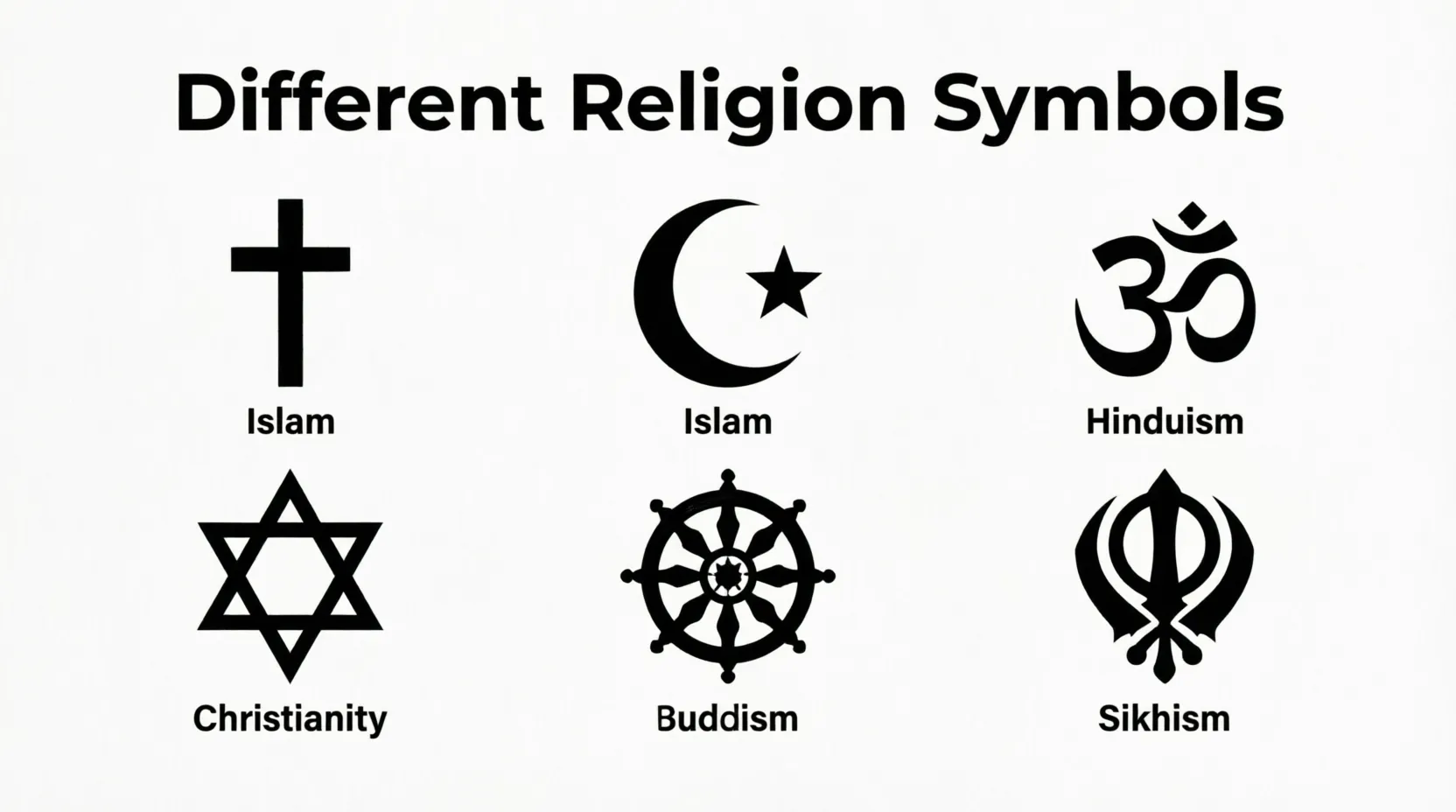
Have you ever wondered why different religion symbols carry such deep meaning across cultures and generations?
Different Religion Symbols reveal powerful stories of faith, spirituality, identity, and human connection, helping people understand beliefs that have shaped communities around the world.
From sacred signs used in worship to symbols representing hope, peace, protection, and divine connection, each mark has its own history and interpretation.
These symbols are more than simple images; they reflect traditions, values, and spiritual ideas passed down through time.
In this article, you will explore the meanings, origins, cultural significance, and symbolism behind some of the most recognized religious symbols from various faiths.
Quick Answer: What Symbol Represents Different Religions?
The most recognized symbols representing different religions include the Cross in Christianity, Om in Hinduism, Star of David in Judaism, Crescent and Star in Islam, Dharma Wheel in Buddhism, and Khanda in Sikhism.
These symbols are often used to express faith, spiritual beliefs, community identity, and religious heritage.
What Are Different Religion Symbols?
Different religion symbols are visual signs, objects, or designs connected to specific religious traditions and spiritual beliefs.
They help followers express devotion, remember teachings, and identify with their faith communities.
These symbols can represent ideas such as peace, devotion, enlightenment, protection, sacrifice, creation, or the relationship between humans and the divine.
However, their meanings are not always identical everywhere. A symbol’s meaning can change depending on cultural background, religious tradition, historical context, and personal interpretation.
People use religious symbols in many ways, including places of worship, clothing, jewelry, artwork, books, tattoos, and home decorations.
Learning about these symbols with respect allows people to understand different beliefs and traditions around the world.
Different Religion Symbols Comparison Table
| Symbol | Main Meaning | Best Use |
| Cross (✝) | Faith, sacrifice, salvation | Jewelry, tattoos, churches |
| Om (ॐ) | Spiritual awareness and divine connection | Meditation art, spiritual designs |
| Star of David (✡) | Jewish identity and faith | Jewelry, cultural designs |
| Crescent and Star (☪) | Islamic identity and tradition | Religious art, cultural symbols |
| Dharma Wheel (☸) | Buddhist teachings and path to enlightenment | Meditation spaces, artwork |
| Khanda (☬) | Sikh faith, courage, and unity | Religious displays, jewelry |
| Yin Yang (☯) | Balance and harmony | Personal designs, philosophy art |
| Torii Gate (⛩) | Shinto spirituality and sacred spaces | Cultural artwork |
| Bahá’í Nine-Pointed Star | Unity of humanity and faith | Jewelry, spiritual designs |
| Jain Hand (🖐) | Nonviolence and spiritual awareness | Religious artwork |
Top 10 Different Religion Symbols and Their Meanings
1. Cross: A Symbol of Christianity and Faith
In Christianity, it represents the crucifixion of Jesus Christ and is connected with beliefs about sacrifice, forgiveness, hope, and salvation.
The cross appears in churches, necklaces, artwork, and personal items.
Many Christians wear cross jewelry or choose cross tattoos as reminders of their faith and spiritual journey.
Different Christian traditions may use variations of the cross, including simple crosses, Celtic crosses, or crosses featuring artistic designs. Each style may carry additional cultural meaning.
Best for:
Christian tattoos, necklaces, church artwork, faith reminders, family religious gifts
2. Om: A Symbol of Hindu Spiritual Meaning
The Om symbol (ॐ) is an important spiritual symbol in Hindu traditions and is also respected in some other Indian spiritual practices.
It is commonly associated with meditation, sacred sounds, spiritual awareness, and the connection between the individual and the universe.
Many people see Om as a reminder of inner peace, mindfulness, and devotion.
Because Om has deep religious roots, it is important to understand its meaning before using it as decoration or body art.
Best for:
Meditation spaces, spiritual artwork, meaningful tattoos, yoga-inspired designs, personal reminders
3. Star of David: A Symbol of Jewish Identity
The Star of David (✡) is a well-known symbol associated with Judaism and Jewish identity. It consists of two overlapping triangles forming a six-pointed star.
Today, it is commonly seen on synagogues, jewelry, cultural artwork, and Jewish community symbols.
For many people, it represents connection to Jewish heritage, faith, and tradition.
The symbol has different historical associations, and its meaning has developed over time. Understanding its connection to Jewish culture is important when using it in designs or artwork.
Best for:
Jewish cultural art, faith jewelry, heritage designs, educational materials, meaningful symbols
4. Crescent and Star: A Symbol Associated With Islam
The Crescent and Star is commonly associated with Islam, although it is not a universal religious symbol required by Islamic teachings.
It has become widely recognized through historical and cultural associations with Muslim communities.
The symbol is often seen on flags, architecture, and cultural designs in many Muslim regions.
Different communities may interpret its meaning differently.
When using this symbol, it is helpful to understand that Islamic beliefs are based primarily on teachings, practices, and the Quran rather than a single visual sign.
Best for:
Cultural designs, educational materials, heritage artwork, architecture-inspired designs
5. Dharma Wheel: A Symbol of Buddhist Teachings
The Dharma Wheel (☸) is an important Buddhist symbol representing the teachings of Buddha and the path toward spiritual understanding.
The wheel often has eight sections connected to the Noble Eightfold Path.
It is associated with wisdom, ethical living, mindfulness, and personal growth. Many Buddhist temples, artworks, and educational materials use this symbol.
The Dharma Wheel is also used by people interested in meditation and spiritual reflection because of its connection with balance and awareness.
Best for:
Meditation areas, Buddhist artwork, spiritual tattoos, educational designs, mindfulness reminders
6. Khanda: A Symbol of Sikh Faith and Values
The Khanda (☬) is a significant symbol in Sikhism. It includes a double-edged sword, a circular shape called a chakkar, and two swords known as kirpans.
The symbol reflects Sikh values such as spiritual devotion, courage, justice, and commitment to helping others. It is commonly displayed in Sikh places of worship and worn by some followers as a representation of faith.
Best for:
Sikh jewelry, religious artwork, cultural education, faith-based designs
7. Yin Yang: A Symbol of Balance and Harmony
The Yin Yang symbol (☯) comes from Chinese philosophy and is often associated with balance between opposing forces.
While it is not a religion itself, it is connected with Taoist thought and ideas about harmony.
The symbol shows how different energies can exist together and create balance. Many people use it as a reminder of acceptance, peace, and personal growth.
Its simple design makes it popular in artwork, tattoos, and decorative items.
Best for:
Balance tattoos, philosophy designs, home artwork, personal growth symbols
8. Torii Gate: A Symbol of Shinto Tradition
The Torii gate is a traditional symbol connected with Shinto practices in Japan.
It marks the entrance to sacred spaces and represents a transition between ordinary areas and places associated with spiritual significance.
Torii gates are commonly found near Shinto shrines and are recognized worldwide through Japanese cultural imagery.
People interested in Japanese culture often include this symbol in artwork, but it should be used with awareness of its spiritual importance.
Best for:
Japanese cultural designs, travel artwork, architecture-inspired art, educational projects
9. Bahá’í Nine-Pointed Star: A Symbol of Unity
The Nine-Pointed Star is associated with the Bahá’í Faith and is often connected with ideas of unity, harmony, and the relationship between humanity and spirituality.
The number nine has special importance in Bahá’í tradition because it is considered a symbol of completeness.
The star appears in some religious and cultural materials.
Best for:
Faith artwork, unity symbols, spiritual designs, educational materials
10. Jain Hand: A Symbol of Nonviolence
The Jain Hand is an important symbol in Jainism. It often includes a wheel in the palm and represents the principle of stopping harmful actions and practicing nonviolence.
The word “Ahimsa,” meaning nonviolence, is often connected with this symbol. It reflects compassion, self-control, and respect for all living beings.
Many people recognize it as a reminder to live with kindness and awareness.
Best for:
Spiritual artwork, educational designs, peace symbols, personal reminders
Best Different Religion Symbols for Tattoos
Religious tattoos can hold deep personal meaning, but they require thoughtful choices.
Popular meaningful options include:
- Cross for Christian faith and devotion
- Om for spiritual reflection
- Dharma Wheel for Buddhist teachings
- Khanda for Sikh identity
- Star of David for Jewish heritage
- Yin Yang for balance and harmony
Small religious tattoos often work well on wrists, arms, shoulders, or behind the ear. Family members may also choose matching spiritual symbols as reminders of shared values.
Best Different Religion Symbols for Logos and Design
A symbol connected to a living faith may have deep significance for followers.
For logos, designers often focus on:
- Simple shapes that are easy to recognize
- Clear visual meaning
- Respectful use of sacred imagery
- Avoiding changes that may appear disrespectful
For example, peace-related or universal symbols may work better for general designs, while specific religious symbols should be used with cultural awareness.
Best Different Religion Symbols for Family, Spiritual, or Personal Meaning
Many people choose religious symbols to represent family values, personal beliefs, or spiritual reminders. These symbols may appear in home artwork, gifts, jewelry, or keepsakes.
Examples include:
- Cross for family faith traditions
- Om for spiritual mindfulness
- Dharma Wheel for personal growth
- Khanda for family heritage
- Yin Yang for balance within relationships
The best symbol is the one that connects with your own values while respecting its original meaning.
Before Using Cultural or Sacred Symbols
Some religious symbols have deep spiritual and cultural roots. Before using one in a tattoo, logo, product, or artwork, take time to learn its origin and meaning.
A symbol that looks beautiful may carry sacred importance for a community. Understanding its background helps prevent accidental misuse or disrespect.
Meanings can also vary between traditions and regions. Respectful use begins with learning, not just copying a design.
How to Choose the Right Symbol for Different Religion Symbols
Choosing the right religious symbol depends on your purpose and personal connection. Consider these points:
- Personal meaning: Choose a symbol that reflects your beliefs or values.
- Visual simplicity: Make sure the design works well for tattoos or logos.
- Long-term value: Choose something meaningful beyond current trends.
A meaningful symbol should tell a story that matters to you.
FAQs
What is the best symbol for different religions?
There is no single best symbol for all religions because each tradition has its own important signs.
Common examples include the Cross, Om, Star of David, Crescent and Star, Dharma Wheel, and Khanda.
What symbol represents peace in different religions?
Many traditions value peace, but symbols vary. The dove, lotus, Dharma Wheel, and certain spiritual signs are often connected with peace, harmony, or compassion in different cultural contexts.
What is a good different religion symbol tattoo?
Popular choices include crosses, Om symbols, Dharma Wheels, and other designs connected to personal beliefs.
What symbol represents spiritual growth?
Several symbols are linked with spiritual growth, including the Dharma Wheel, Om, lotus imagery, and other faith-based designs that represent reflection, wisdom, or transformation.
What is a simple religious symbol for a tattoo?
Simple designs like a small cross, Om symbol, Star of David, or Dharma Wheel can work well because they are recognizable and meaningful without needing complex details.
Can religious symbols be used in logos?
Yes, but they should be used carefully. Businesses and designers should understand the cultural meaning of a symbol and avoid using sacred imagery in ways that may seem disrespectful.
Are all religious symbols recognized worldwide?
No. Some symbols are widely known internationally, while others are important mainly within specific communities or traditions.
Final Thoughts
Different religious symbols offer a window into the beliefs, histories, and values of communities around the world.
From the Cross and Om to the Dharma Wheel and Khanda, each symbol carries its own story and meaning.
The most valuable symbol is one that reflects respect, knowledge, and a connection to what you truly believe.

Ethan Caldwell is an experienced American author at BlogShubb. He specializes in technology, online platforms, and digital trends. His well-researched articles make complex topics easy to understand and provide readers with clear, practical, and reliable information.
 Owen Bradford
 Dylan Prescott